
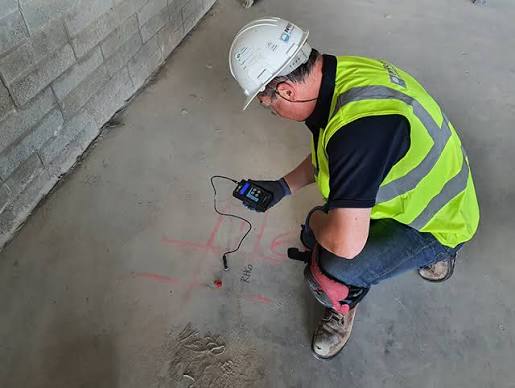
Concrete looks solid and dry. That is exactly what makes it deceptive. A slab can hold and release moisture for months or even years, and when new flooring is laid over it, that vapor goes to work: lifting adhesive, warping planks, growing mold, and turning an expensive new floor into a very expensive mistake. Testing before you install takes little time and can save you thousands. It can also decide whether your flooring warranty is valid.
Why moisture is such a problem
Concrete is porous. Water vapor from the ground moves up through the slab, a process called moisture vapor transmission. Even an old slab with no visible dampness can emit enough vapor to damage flooring that is sensitive to moisture. The risk is highest in basements, slabs on grade, homes in humid climates and houses with poor drainage or high water tables. Symptoms of a problem include cupping or buckling floors, peeling vinyl, loose tiles, musty smells and white powdery deposits called efflorescence on the surface.
Start with a simple home test
The plastic sheet test is an easy first check, though it is not a substitute for a proper test. Tape a piece of clear plastic, about two feet square, firmly to the concrete on all sides. Leave it for 24 to 72 hours. If you see condensation underneath or the concrete looks darker, there is moisture coming up. This is a rough indicator only, and many manufacturers do not accept it for warranty purposes.
Calcium chloride test
This commonly used test measures the amount of moisture vapor emitted from the surface over a period of 60 to 72 hours. A dish of calcium chloride is weighed, placed under a sealed dome on the clean slab, then reweighed. The weight gain shows how much moisture came out. The result is expressed in pounds of moisture per 1,000 square feet per 24 hours. Many floor coverings specify a limit in the range of three to five pounds, though individual products differ. One limitation is that the test measures only the surface of the slab.
Relative humidity probe test
This method is widely considered more reliable. Small holes are drilled into the slab to a depth of about 40 percent of its thickness for a slab drying from the top only, and a sensor measures the relative humidity inside. After the holes sit for a set period, usually 24 hours, readings are taken. Many manufacturers specify a maximum of around 75 to 85 percent relative humidity, depending on the product. Because it reads conditions within the slab, it captures moisture that may rise to the surface later. Professionals often perform this test according to recognized standards, which also specify the number of tests per area.
Moisture meters
Handheld meters can be useful for quick scans to find damp areas, but most are not accurate enough for a warranty-grade decision on concrete. Use them to pinpoint where to put more rigorous tests.
What to do if the reading is too high
Do not install and hope for the best. Options include allowing more time for the slab to dry with dehumidifiers and ventilation, improving exterior drainage, fixing leaks, and applying a moisture mitigation system such as a penetrating sealer or an epoxy vapor barrier. Some flooring is designed to tolerate moisture better, such as certain vinyl planks, but even those have limits. Follow the manufacturer’s installation instructions and use approved underlayments.
The warranty angle
Most flooring warranties exclude failures caused by moisture unless the installation conditions were met and documented. Read the installation guide for your product, which will state moisture limits and the accepted test methods. Keep test records with date, location, readings and the name of the person who performed them. If a dispute arises with a contractor or manufacturer, documentation can make or break your claim.
Contracts and responsibility
If you are hiring an installer, ask in writing who is responsible for moisture testing and what happens if the results are outside the limit. Some contractors include testing in their scope, while others require the owner to provide results. Clarifying this avoids finger-pointing later.
Timing matters
New concrete needs time to cure and dry, and a common rule of thumb is about a month per inch of thickness, but that is only an estimate. Test it rather than guess.