
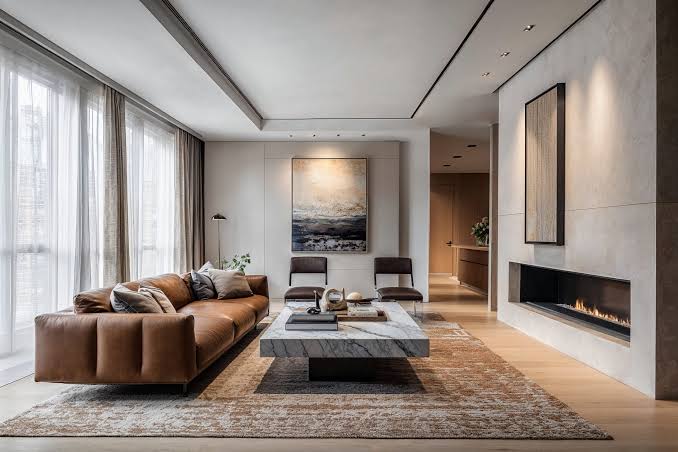
If you want to improve a room without repainting or buying new furniture, change the lighting. One harsh overhead fixture is the quickest way to make a space feel flat and unwelcoming, no matter how beautiful the furniture. Designers almost never rely on a single source. They use layers: several kinds of light that work together to make a room functional, flattering and flexible. You can do the same.
The three main layers
Ambient lighting is the general illumination that fills the room. It might come from ceiling fixtures, recessed lights, wall sconces or large floor lamps. Its job is to let you move around safely and see comfortably.
Task lighting is focused light for specific activities, such as reading, cooking, applying makeup or working at a desk. Think under-cabinet strips in the kitchen, a desk lamp, a reading light beside the bed or vanity lights in a bathroom.
Accent lighting highlights features, such as artwork, bookshelves, plants, textured walls or architectural details. Picture lights, spotlights, LED strips and small uplights fall into this group. Accent lighting adds depth and drama.
A fourth layer, decorative lighting, covers fixtures like chandeliers, pendants and sculptural lamps that serve as design elements as well as light sources.
Why layers beat a single source
A single overhead light casts shadows on faces and flattens textures. Layers let you control the mood: bright for cleaning and homework, soft for movie night, intimate for dinner. They also reduce eye strain, because light comes from multiple angles rather than glaring from above.
Choosing the right color temperature
Bulb color is measured in kelvin. Around 2700K to 3000K gives a warm, cozy glow, suitable for living rooms, bedrooms and dining areas. About 3500K to 4000K is neutral white, good for kitchens and bathrooms. 5000K and above resembles daylight, which can feel harsh in residential settings but is useful in workspaces or garages. Keep colors consistent within a room, since mixing very different temperatures can look jarring.
Brightness: look at lumens
Lumens measure how much light a bulb produces, while watts measure energy use. A living room might need roughly 10 to 20 lumens per square foot as a rough guide, while kitchens and workspaces need more. Use dimmers to adjust brightness to suit activities, since dimmable LED bulbs are widely available. Check that bulbs and dimmers are compatible to avoid flickering.
Room-by-room ideas
Living room: Combine a ceiling fixture on a dimmer, floor lamps in the corners, a table lamp beside the sofa and accent lights on artwork. Place lamps at different heights to avoid pools of darkness.
Kitchen: Use bright general lighting, under-cabinet task lights for counters and pendants over an island. Add warm accents or lights inside glass cabinets.
Bedroom: Soft ambient light, bedside lamps or wall-mounted reading lights and perhaps a dimmable overhead. Avoid bright, cold light before bed.
Bathroom: Place vanity lights at face level on both sides of the mirror to reduce shadows, and add a diffused overhead light. Fixtures must be rated for damp or wet locations as appropriate.
Home office: Use a desk lamp that minimizes glare on the screen, plus ambient light to reduce contrast with the monitor. Position the light source to the side rather than behind the screen.
Entry and hallway: Provide enough light for safety, and add a console lamp or wall sconce for welcome.
Avoid common mistakes
Do not install recessed lights in a perfect grid with no variety. Do not use bulbs of mismatched colors. Do not forget about the lighting at head height, since lamps and sconces add warmth that overheads cannot. Do not skip dimmers.
Safety and legal points
Follow the maximum wattage ratings on fixtures, even with LEDs, as they affect heat. Use fixtures rated for the location, such as damp-rated lights in bathrooms. New wiring, recessed lighting in insulated ceilings and hardwired fixtures can require permits and licensed electricians in many areas, and insulation-contact ratings matter. Plug-in lamps and sconces are an easy, renter-friendly way to add layers without touching the wiring.
Energy and cost
LED bulbs use far less electricity and last much longer than older bulbs. Smart bulbs and plugs allow scheduling and scenes, though they require a compatible system and may collect data, so review privacy settings.
Build it gradually
Start with what is missing. Many rooms have ambient light but lack task or accent layers. Add a lamp, a dimmer or an under-cabinet strip, and you will see the difference immediately.