
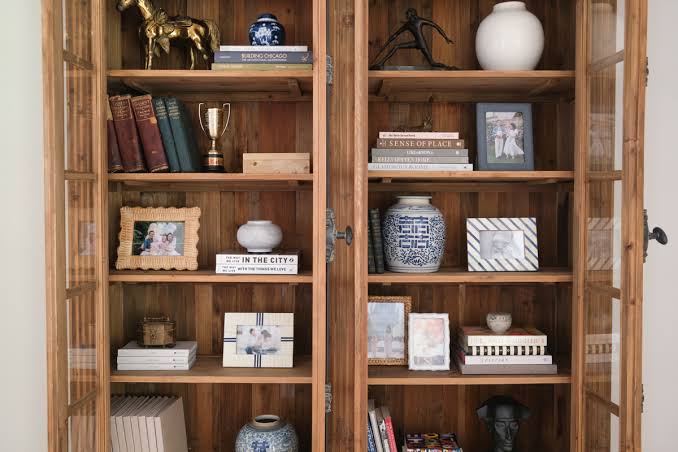
A bookshelf can be the most personal piece of furniture in your home, or the most chaotic. Books slump sideways, random objects crowd the edges and every shelf seems to have a different logic. The good news is that styling a shelf is less about talent and more about a few simple principles. Once you know them, you can make any bookcase look curated and calm.
Start by emptying it
Take everything off the shelves. This feels dramatic, but it lets you clean, see the bare structure and start with a blank slate. Sort your belongings into categories: books, decorative objects, photographs, plants, baskets and things that do not belong on display. Be ruthless about removing items that are broken, dull or just clutter.
Decide the role of the shelf
Is it primarily storage, display or a mix? A shelf that holds your whole library will be styled differently than one that serves as a gallery. Most people want a blend: books for function, objects for personality. Knowing the ratio helps you edit. A common guideline is roughly 60 percent books and 40 percent decorative items, but adjust it to suit you.
Pick a palette
Choose two or three main colors, plus a neutral, and let those guide your selection. You might choose warm wood tones, cream and navy, or a monochrome scheme of black and white. Paper dust jackets can be removed or covered to calm a riot of colors. Some people arrange books by color, creating a gradient effect, while others keep them by subject. Either is fine, as long as it looks intentional.
Mix vertical and horizontal
Variation prevents monotony. Stack some books horizontally, and use those stacks as platforms for small objects. Keep others upright, with a few leaning on a bookend or a piece of decor. A mix of orientation gives the eye something to follow. Avoid lining everything in a straight row like soldiers.
Use the rule of thirds and odd numbers
Groups of three or five feel more natural than pairs. Arrange objects in triangular compositions, with a tall item, a medium one and a short one. This makes the grouping dynamic. Vary heights across the shelf, so that a tall vase on one level is balanced by a stack of books on another.
Layer depth
Shelves are three-dimensional. Place larger items at the back, medium ones in front and the smallest in front of those. Lean a framed print or a mirror against the back panel, and put a small sculpture or candle in front of it. Layering adds richness and depth.
Leave breathing room
Negative space is not wasted space. Empty areas let your eyes rest and make the displayed pieces stand out. Resist the urge to fill every inch. If a shelf feels crowded, remove one item and see if it improves.
Add personality with meaningful objects
Incorporate items that tell your story: travel souvenirs, family photos, handmade ceramics, vintage finds, a favorite plant. Mix textures such as wood, glass, metal and ceramic. Plants, especially trailing ones, soften the lines of the shelf. Baskets and boxes hide less attractive items while adding texture.
Balance the whole unit
Step back and look at the bookcase as a whole. Does one side look heavier? Are the dark colors clustered on one shelf? Distribute visual weight evenly, but not rigidly symmetrical. A balanced arrangement can be asymmetrical, with different items of similar visual weight on each side.
Lighting and the backdrop
A bookcase looks better with good lighting. Consider small LED strips, picture lights or nearby lamps. Painting or wallpapering the back panel in a contrasting color can add drama and make objects pop.
Safety and rules for renters
Heavy bookcases should be anchored to the wall, particularly in homes with children or pets. If you rent, ask your landlord about using wall anchors, and avoid overloading shelves beyond their weight limits. Keep heavier items on lower shelves for stability.
Refresh seasonally
Swap a few items every season. A new plant, a different print or a fresh stack of books can change the entire mood without effort. Your shelf should evolve with you.